610-945 CE
The Arabs were the Semitic-speaking peoples of the Arabian peninsula who, united by Islam in the seventh century, burst out of the desert and built a caliphate stretching from Spain to Central Asia within a single lifetime.
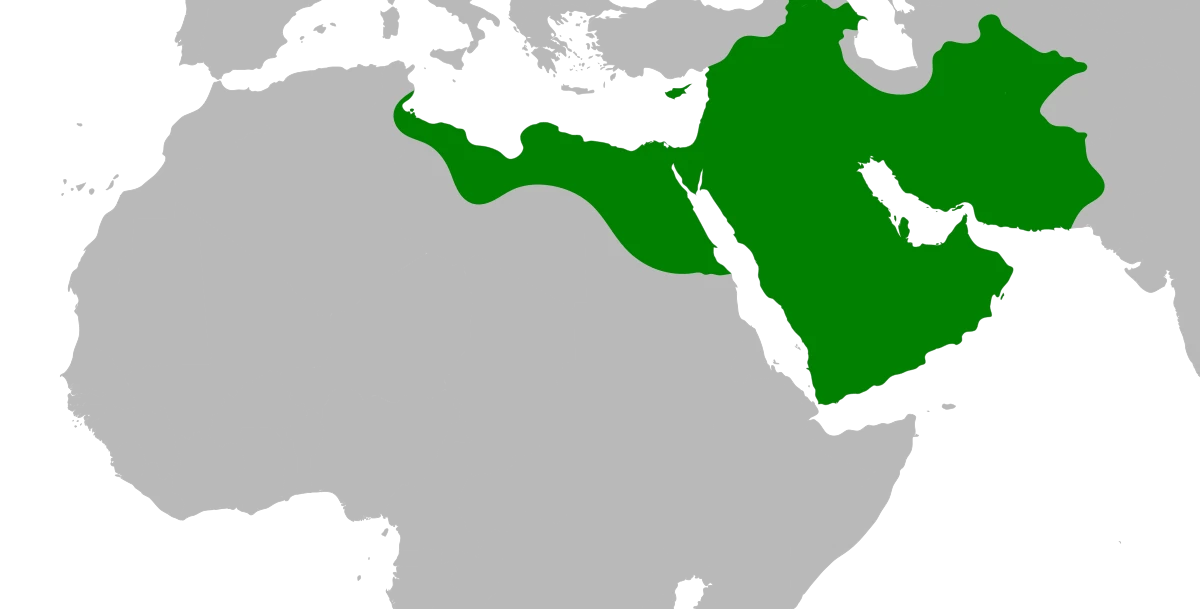
The Arabs were Semitic-speaking peoples who had inhabited the Arabian peninsula for millennia before the rise of Islam made them the rulers of an empire. Roman and Persian writers knew them as desert traders, camel herders, and occasional raiders who occupied the margins of the civilized world. The peninsula itself was mostly arid steppe and sand desert, punctuated by oases and a fertile strip along the southwestern coast in Yemen. The Arabs who lived there were divided into tribes bound by kinship, custom, and the relentless arithmetic of water and pasture.
Islam transformed this fragmented world into a political and military force of extraordinary speed and coherence. Within a century of Muhammad's death in 632, Arab armies had conquered the Sassanid Persian empire entire and stripped Byzantium of its richest provinces. The caliphate that resulted was the largest state the world had seen since Rome.
Arabia before Islam was a land of sharp contrasts. The Bedouin of the interior lived as pastoral nomads, moving with their camels, goats, and sheep between seasonal water sources. A Bedouin family's tent of woven goat hair was home, shade, and fortress. Hospitality to travelers was a survival ethic as much as a moral code: a man who turned a stranger away from his fire knew that he might be the stranger at someone else's camp next season.
The trading cities told a different story. Mecca sat on the caravan routes that carried incense, spices, and Indian Ocean goods north to the Mediterranean. Its merchants were sophisticated, literate, and wealthy. A trader in Mecca handling bales of Yemeni frankincense and bolts of Indian cloth operated in a commercial network that stretched from East Africa to Syria. Medina, to the north, was an oasis town of date palms and irrigated fields. The contrast between desert nomad and city merchant defined Arab society and continued to shape it long after the conquests carried both types far from the peninsula.
The early Arab conquests were driven by light cavalry and infantry that moved fast, fought with conviction, and exploited the exhaustion of their opponents. Persia and Byzantium had spent decades bleeding each other in inconclusive wars, and their frontier provinces were weakly held. Arab armies offered the populations they conquered a straightforward deal: submit, pay a tax, and keep your property and religion. Resist and face the consequences. Most chose submission. The speed of the conquest owed as much to this pragmatism as to military prowess.
The caliphate's political structure strained under its own size. The Umayyad dynasty, ruling from Damascus, held things together for nearly a century before the Abbasid revolution of 750 shifted the capital to Baghdad and reoriented the empire eastward. By the ninth century the caliphate was fragmenting into autonomous provinces and rival dynasties, each acknowledging the caliph's nominal authority while governing independently. The Arab monopoly on power within the Islamic world eroded as Persian, Turkish, and Berber elites asserted themselves.
Islam provided the framework that unified Arab society and gave the conquests their ideological coherence. The five pillars, profession of faith, prayer, fasting, charity, and pilgrimage, structured daily life for believer and community alike. Zakat, the obligation of charitable giving, was not voluntary kindness but a calculated tax on wealth, redistributed to support the poor, the elderly, travelers, and debtors. A merchant in eighth-century Baghdad calculating his zakat obligation was performing an act simultaneously religious, social, and fiscal.
Arab culture before and after Islam placed enormous value on language. Poetry was the prestige art form, and a skilled poet could make or destroy a reputation with a few well-aimed verses. The Quran itself was received as a literary miracle, its Arabic prose considered inimitable. Memorizing and reciting it was both worship and education. A boy in a Basra mosque in the eighth century learning to recite surahs by heart was being trained simultaneously in theology, grammar, and the rhythms of the most influential text in the Arabic language.
The Arab caliphate created a single economic zone from the Atlantic to the borders of China. Goods, ideas, and people moved across this space with a freedom that had not existed since Rome and would not exist again until the modern era. Arab merchants traded in every ocean. Arab scholars translated Greek philosophy, Indian mathematics, and Persian medicine into Arabic, preserving and extending knowledge that would later pass to medieval Europe. The numerals used on this page are called Arabic for a reason, though the Arabs themselves adopted them from India.
Baghdad under the early Abbasids was the largest and wealthiest city in the world, a round city built on the Tigris where scholars, merchants, and administrators from every corner of the Islamic world mixed in the markets and libraries. The House of Wisdom gathered translators who worked through the Greek philosophical corpus systematically, making Aristotle, Euclid, and Galen available in Arabic to readers who would carry them further than their original authors could have imagined. The Arab world did not merely preserve classical learning; it argued with it, extended it, and sent it onward.


 for each of your
  . Then, gain 2
for each of your
. Then, gain 2
for each of your 
 for each of their Markets

In the game, the Arabs profit from everyone's commerce. Coins flow in whenever any player trades, and religious communities offset the cost of governing your provinces. Theocracy and Islam arrive free before turn one. Try to end every round with zero coins, spending everything before the achievement phase. Your province upkeep becomes meaningless, and the double income from religious communities makes spreading faith your highest priority.
Yes. The ability triggers when "any player trades," including yourself. You gain 1 coin for each market the trading player has, so when you trade, you profit from your own markets.
Yes. You gain 1 coin for each of their markets, including any virtual markets from alliance abilities or other effects.
You simply pay what you can. The payment is not a penalty, and failing to pay the full amount does not harm you. Afterward you gain 2 coins per religious community and collect taxes normally.
Yes. Your free action sets your starting configuration, but a Reform action later in the game lets you change government or religion if you wish.
Yes. The virtual market counts as a real market for all purposes, including tax collection.