567-803 CE
The Avars were a nomadic warrior elite from the Central Asian steppe who arrived in the Carpathian basin in the late sixth century, built a khaganate that dominated central Europe for two centuries, and ruled their Slavic subjects from vast circular fortifications called hringr.
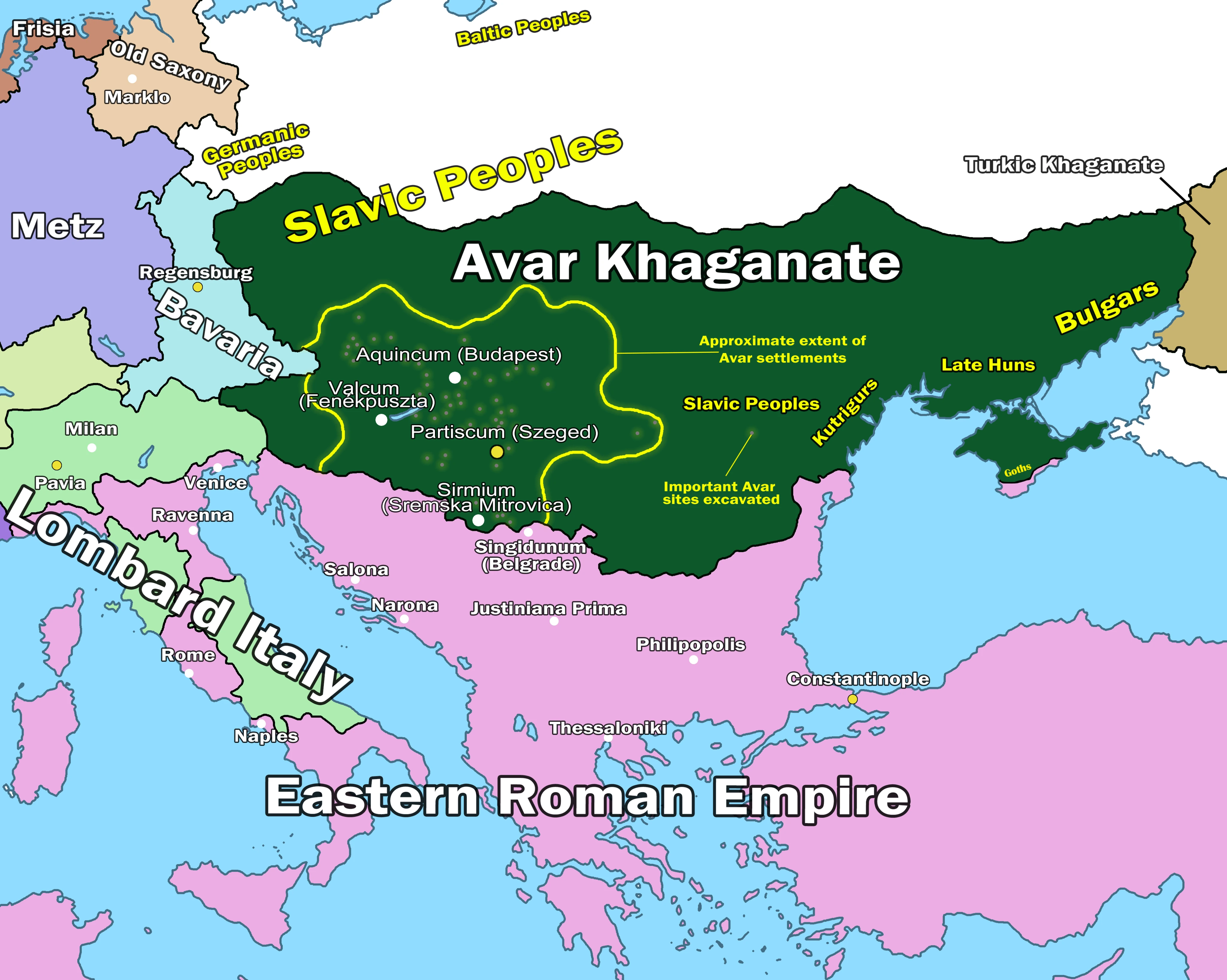
The Avars appeared on the western steppe in the 560s, refugees or fragments of a larger nomadic world shattered by the Göktürk expansion across Central Asia. Byzantine sources called them "pseudo-Avars," implying they had adopted the name of an older, more prestigious steppe people to enhance their authority. Whether genuine or borrowed, the name worked. Within a decade of crossing the Danube they had destroyed the Gepid kingdom, driven the Longobards into Italy, and established a khaganate centered on the Carpathian basin that would dominate central Europe for over two hundred years.
They were a military aristocracy, not a mass migration. The Avar elite numbered perhaps in the tens of thousands. They ruled over a much larger Slavic, Gepid, and Bulgar population whose labor fed the khaganate and whose soldiers filled the lower ranks of its armies.
The Hungarian plain suited the Avars as it had suited the Huns before them: flat grassland that could support the horse herds on which steppe power depended. The Avars occupied this landscape as overlords. Slavic farmers worked the river valleys and forest clearings around the periphery, growing grain and raising livestock that supplied the Avar camps. The relationship was extractive. Tribute flowed inward from subject communities to the khagan's court; in return, the subjects received the privilege of not being raided.
The Avars themselves lived as pastoralists and warriors. Their camps were seasonal, following the grass, though the khaganate's center of gravity remained in the Tisza river region. Horses were the foundation of everything: transport, warfare, wealth, and status. A man's standing was visible in the quality of his mount and the gold fittings on his belt. Avar belt sets, elaborately cast in bronze or gold with griffin and vine-scroll motifs, are among the most distinctive artifacts of early medieval central Europe. A warrior buried with his horse, his bow, and a full set of gilded belt plates was declaring his rank to the afterlife.
Avar cavalry combined the mounted archery of the eastern steppe with the stirrup, a technology the Avars helped spread into Europe. The stirrup gave a rider stability for both shooting and lance combat, and Avar horsemen exploited this advantage mercilessly. They besieged Constantinople itself in 626, in alliance with the Persians, though the attack failed. Their armies raided deep into Byzantine territory and extracted tribute that kept the khaganate's gold economy flowing.
The khaganate's weakness was structural. The Avar elite depended on continuous tribute and plunder to maintain loyalty, and when the flow slowed, the system cracked. Slavic subject peoples in the west revolted under Samo in the 620s and established an independent confederation. By the late eighth century the khaganate was weakened by internal conflict. Charlemagne's campaigns of the 790s delivered the final blow. Frankish armies breached the great ring fortresses and carried away treasure accumulated over two centuries of raiding and tribute extraction. The chroniclers recorded wagon-loads of gold leaving the Avar heartland for Aachen.
Almost nothing is known about Avar religion from internal sources. They left no texts. Archaeological evidence suggests practices common to steppe peoples: horse sacrifice, weapon burial, offerings of food and drink placed with the dead. Shamanic traditions likely persisted, though by the seventh century some Avars had encountered Christianity through Byzantine contact and captive populations. Conversion, such as it was, came late and under Frankish pressure after the conquest.
The most distinctive feature of Avar material culture was the ring fortress, the hring. These were enormous circular earthwork enclosures, sometimes nested in concentric rings, that served as the administrative and ceremonial centers of the khaganate. Inside the rings the khagan held court, stored treasure, and received tribute. The rings were not cities in any conventional sense: they contained no permanent stone buildings, no markets, no resident civilian population. They were power made visible in earth and timber, symbols of authority stamped onto the landscape. A Slavic farmer bringing his annual tribute of grain and livestock to the outer gate of a hring was entering a space designed to remind him of his place in the order of things.
The Avars were intermediaries between the steppe and Europe, carrying technologies and cultural practices westward. The stirrup, certain styles of cavalry equipment, and possibly the heavy wooden saddle with a high cantle all entered European use through Avar channels. Their gold-working combined steppe animal styles with Byzantine and Germanic motifs, producing a hybrid decorative tradition that influenced metalwork across central Europe.
After the Frankish conquest the Avars disappeared as a distinct group within a few generations, absorbed into the Slavic and Frankish populations around them. The ring fortresses were abandoned and plowed over. The name survived in Slavic place-names and in a few chronicle references to "Avar remnants" living under Frankish or Bulgar authority. Their most lasting legacy may be the political vacuum their collapse created in the Carpathian basin, a vacuum that the Magyars would fill a century later, beginning the cycle of steppe peoples occupying the Hungarian plain once again.

 for each of your Castles


 / 3
/ 3  from
each hex where your
from
each hex where your  is located


 for each
In the game, the Avars rule without working the land. No gathering, no cities: peasants extract tribute wherever they stand, and cheap castles built from Age I serve as the great hring fortifications that anchor your power. Each castle adds production capacity, making your strongholds the economy itself. Spread peasants wide for maximum tribute, build castles early for production, and invest in markets. Do not be afraid to trade aggressively; your economy works differently from everyone else's, so lean into it.
Yes. Each Castle allows you to produce up to +1 product of any type. You can place an action cube in the corresponding area and produce 1 product even without the matching economic building.
The resource that matches the hex type: wood from forest, stone from mountains, food from meadows and sea hexes. Your peasants generate the resource matching their terrain, or 3 coins regardless of hex type.
Yes. Calamities forbid gathering resources, but your ability says you gain resources, which is a different mechanic. Your peasants still provide their corresponding resources or coins regardless of calamities.
Yes, as long as you have your starting city. You can recruit peasants normally. However, protect your starting city carefully. If it is destroyed, you cannot rebuild it, which will severely limit your options.
No. Elite units only become available from Age II onward. Castles built in Age I do not unlock elite units early.
The ability sets the stone cost for Avar castles at the normal cost minus 3 stone. If you have other abilities or technologies that further reduce construction costs, they apply on top of this discount unless they specify otherwise.