1-106 CE
The Dacians were a Thracian people who built a mountain kingdom in the Carpathians, forged curved swords that terrified Roman legions, and held their ground against the empire until Trajan's wars ground them down in the early second century.
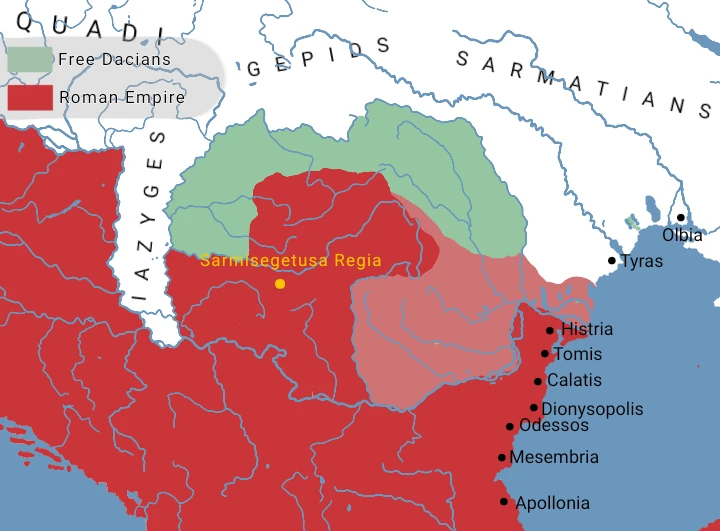
The Dacians were a Thracian-speaking people who occupied the Carpathian mountain arc and the Transylvanian plateau, a natural fortress of forested peaks and river valleys that gave them both isolation and defensibility. Greek and Roman writers grouped them with the Getae to the south, and the two names may describe the same people seen from different directions. By the first century BCE the Dacians had consolidated into something rare among the peoples north of the Danube: a centralized kingdom with a capital, a priesthood, and a military capacity that Rome could not ignore.
Their window in the common era was narrow. A century of confrontation with Rome ended in 106 CE when Trajan's legions stormed their mountain fortresses and turned Dacia into a province. But that century produced one of Rome's most dangerous enemies.
The Carpathians gave the Dacians everything they needed and made them hard to reach. Dense beech and oak forests covered the slopes. Mountain pastures supported sheep and cattle in summer. The valleys held fertile soil for wheat, barley, and millet. Iron ore was abundant, and the Dacians mined gold and silver from deposits that would later make the province one of Rome's most profitable conquests.
Villages clustered in the valleys and on terraced hillsides, built from timber and daub with shingled roofs. A Dacian household stored grain in clay-lined pits dug into the ground and kept bees in hollowed logs leaned against the south-facing wall of the house. Women wove wool on upright looms and made pottery by hand without a wheel, a conservatism that coexisted oddly with sophisticated metalwork. The contrast was typical: a people who built stone-walled fortresses on mountaintops using Greek-influenced masonry techniques while their villages below looked much as they had for centuries.
The weapon that defined the Dacians was the falx, a long curved blade mounted on a pole that could reach over a shield rim and split a helmet in a single stroke. Roman legionaries facing the falx for the first time took casualties so severe that Trajan ordered reinforced cross-braces added to their helmets, one of the few times a barbarian weapon forced a change in standard Roman equipment. The falx was a two-handed weapon, which meant the fighter carried no shield. This was not recklessness but a tactical choice: the blade's reach and cutting power compensated for the lack of defense.
Decebalus, the last Dacian king, proved a resourceful enemy. He fortified the mountain passes, hired Sarmatian cavalry, and used diplomacy to buy time between Roman campaigns. His capital at Sarmizegetusa Regia sat on a mountain plateau ringed by stone walls and sacred precincts. Trajan needed two full wars, in 101-102 and 105-106, to break the kingdom. Decebalus killed himself rather than be captured, and his severed head was displayed in Rome. The story is carved in stone on Trajan's Column, where Dacian warriors with their curved swords fight panel after panel against the legions.
Dacian religion centered on Zalmoxis, a deity or deified ancestor who promised his followers immortality. According to Herodotus, the Dacians sent a messenger to Zalmoxis every five years by throwing a man onto upraised spears; if he died, the god was listening. The story may be garbled, but it points to a religious culture that took death seriously and did not fear it in the way their Mediterranean neighbors did. Warriors who believed they would live again fought with a conviction that unsettled even disciplined Roman troops.
A priestly class held considerable power, possibly enough to rival the kings. The sacred precinct at Sarmizegetusa included a circular stone sanctuary and an andesite sun-disc whose astronomical alignments suggest a calendar function. Dacian society was sharply divided between a cap-wearing aristocracy, the pileati, and a bareheaded common class, the comati. The distinction showed in dress, burial, and access to the hilltop sanctuaries where the priesthood conducted its rites. A bareheaded farmer bringing a sheep up the mountain path for sacrifice stood outside the stone walls while the capped men went in.
The Dacians traded with the Greek world through Black Sea colonies and with Celtic neighbors to the west. Greek pottery, wine amphorae, and coins circulated in Dacian settlements, and Greek architectural techniques influenced the construction of their mountain fortresses. Roman merchants operated along the Danube frontier, and Roman silver coins became a standard medium of exchange in Dacia long before the conquest.
After 106 the province of Dacia was colonized intensively. Settlers arrived from across the empire, and the Latin language took root so deeply that modern Romanian descends from it. The Dacian language vanished, surviving only in a handful of plant names recorded by ancient pharmacologists and in place-names that linguists still argue about. The mountain fortresses were abandoned and left to the forest. But the Dacians persist as a national origin story in Romania, where Decebalus and the falx-wielding warriors of Trajan's Column are as familiar as any figure in the country's history.


 ,
gain 1 available
,
gain 1 available 


In the game, the Dacians open every battle with the falx, discarding a white cube before draws begin to strip enemy protection. Sacred sites double as forges, so protect your relics and they will arm you in return. Consider skipping forge construction and exploration in the first round; choosing your government earns a free infantry unit. Invest heavily in buildings early and do not hesitate to rearrange them on your player mat between areas as your strategy shifts.
After bag preparation, you may remove 1 white cube from the bag entirely. This reduces your opponent's protection before the battle drawing begins, making your attacks more likely to deal damage.
An available unit is one not forbidden by your nation and supported by your structures such as a Barracks. You must have the appropriate structure to gain that unit type.
No, you can still gain a peasant. Peasants do not require a Barracks, so they are always available as a fallback option when you lack military structures.
During the achievement phase, you may move up to 4 building tokens on your player mat from one area to another. Empty slots on the mat represent buildings already constructed on the map, while tokens still on the mat are unbuilt. So if you have 2 empty slots in the market area, that means you have 2 markets built. Moving 2 tokens from the barracks area onto those empty market slots transforms those 2 markets into 2 barracks. You traded this round using the markets, and next round you can recruit troops with your new barracks.
Yes, the same principle. Each active relic gives you a virtual Forge. This Forge generates 1 coin in taxes and lets you produce extra weapons immediately. If you have 2 active relics, you have 2 extra Forges on top of any you have built.