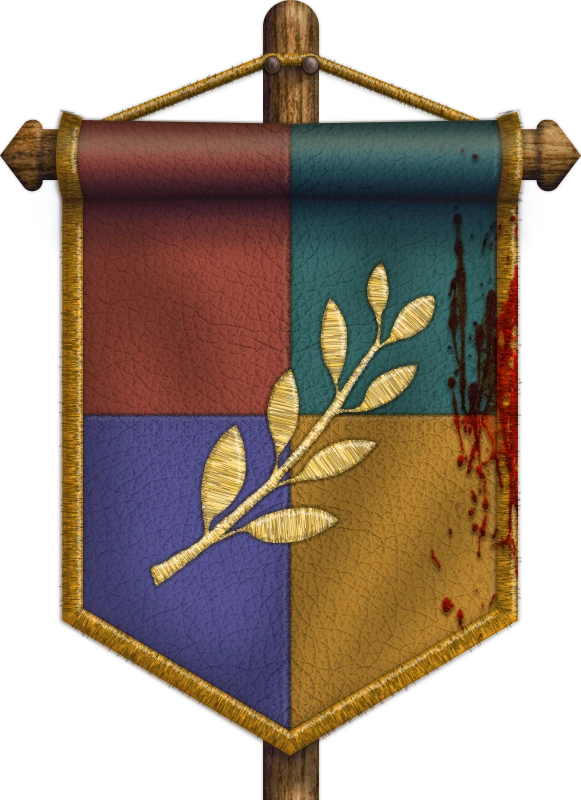
552-744 CE
The Göktürks were the first Turkic people to build a steppe empire under their own name, forging a khaganate that stretched from Manchuria to the Black Sea and gave the word "Turk" to history.
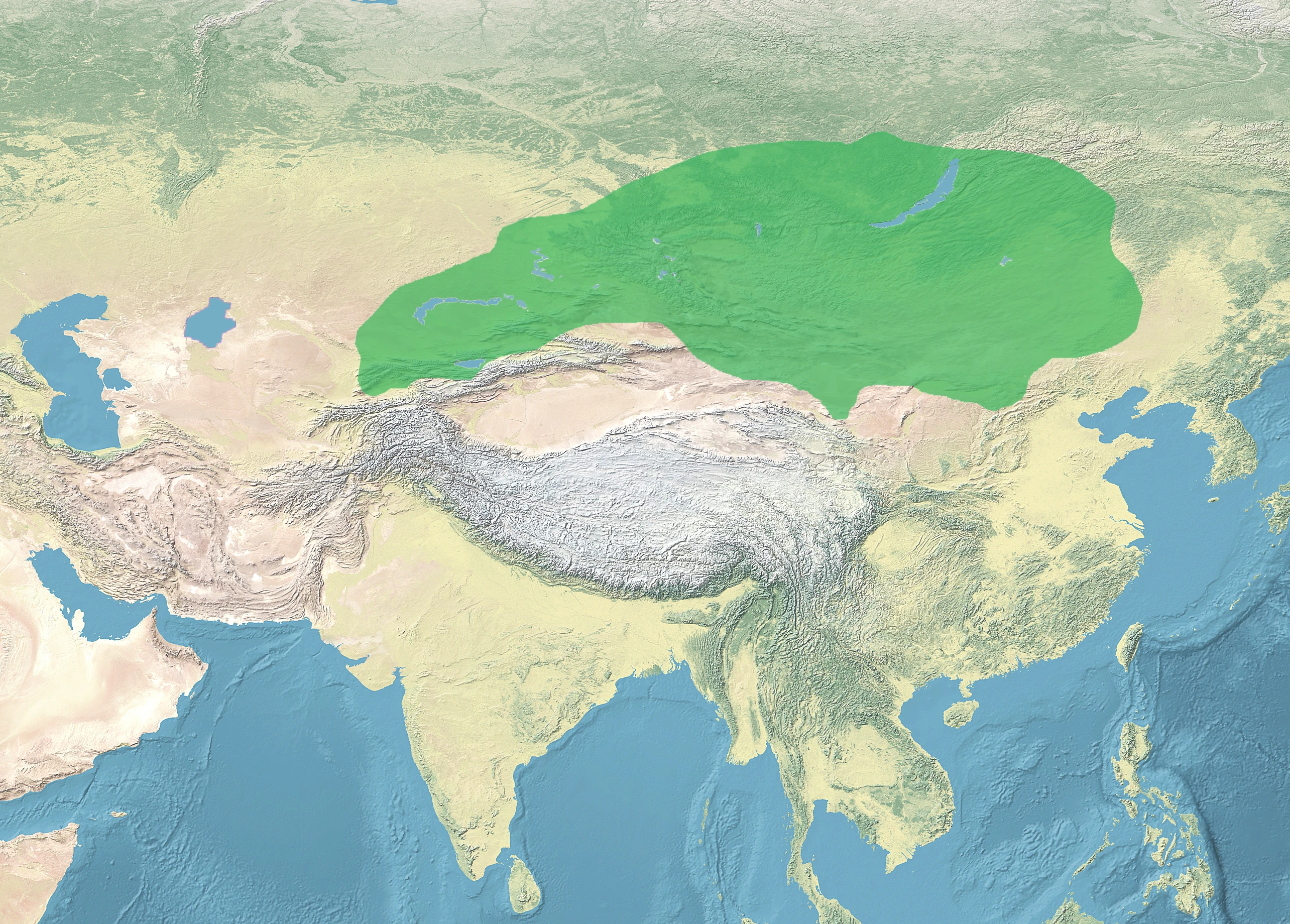
The Göktürks were a Turkic-speaking clan confederation that overthrew its Rouran overlords in 552 and within a generation controlled the largest steppe empire the world had yet seen. The ruling Ashina clan claimed descent from a she-wolf, a founding myth they shared with several Inner Asian peoples and took seriously enough to display wolf-head standards at the head of their armies. The name "Türk" may have meant "strong" or "helmet," and the Göktürks were the first people to carry it as a political identity rather than a vague ethnic label.
Their empire split into eastern and western khaganates within decades of its founding, reunited briefly, and collapsed permanently in the 740s. But in the intervening two centuries they reorganized the political geography of Central Asia and established the template that every subsequent Turkic and Mongol empire would follow.
The Göktürk heartland lay in the Altai mountains and the Mongolian steppe: a landscape of high grassland, cold winters, and short fierce summers. The population lived in felt tents, moved with their herds of horses, sheep, and cattle, and measured wealth in livestock. A prosperous family might own hundreds of horses. A poor one survived on a handful of sheep and the charity of kin.
There was no agriculture in any settled sense. The steppe provided grass for animals, and animals provided everything else: meat, milk, leather, sinew for bowstrings, dung for fuel. A woman fermenting mare's milk into kumiss in a leather bag hung from the tent frame was processing the staple drink of the entire steppe world. When pasture ran thin, camps moved. When winter came hard, the weakest animals died and the people ate what they had stored. The margin between sufficiency and hunger was always narrow, and it closed fast.
Göktürk cavalry was the instrument that built the empire and the reason it held together. Every adult male was a mounted warrior. The composite bow, fired from horseback at full gallop, was the primary weapon, but Göktürk riders also carried lances and straight swords for close combat. Their horses were small, hardy, and could survive on grass alone, which meant Göktürk armies could cover distances that would have starved the grain-fed mounts of settled kingdoms.
The khaganate's military reach was extraordinary. Göktürk armies fought the Sassanid Persians, negotiated with Byzantium, clashed with Tang China, and pushed westward to the fringes of Europe. The Avars who arrived in the Carpathian basin in the 560s were likely refugees from Göktürk expansion. But the empire's size was also its vulnerability. Communication across thousands of kilometers of steppe depended on relay riders and personal loyalty, and when the khagan's authority weakened, the periphery broke away. The split between eastern and western khaganates in the late sixth century was permanent in all but name.
The Göktürks worshipped Tengri, the Eternal Blue Sky, a supreme deity common to most Turkic and Mongol peoples. Sacred mountains, springs, and particular trees received offerings. The khagan ruled by the mandate of Tengri, and his authority was legitimate only as long as heaven favored him. Military defeat could be interpreted as a withdrawal of divine support, which made every lost battle a political crisis as well as a military one.
The Orkhon inscriptions, carved in runic Turkic script on stone monuments in Mongolia in the early eighth century, are the oldest known texts in any Turkic language. They record the deeds and complaints of Göktürk rulers with a directness that no court chronicle would have permitted. "The Turkic people did not recognize their own khagan," reads one passage, a blunt admission of political failure carved in stone for eternity. The inscriptions also describe the ideal relationship between ruler and people in terms that are contractual rather than divine: the khagan feeds and clothes the people, and the people fight for the khagan. When either side breaks the bargain, the arrangement ends.
The Göktürk khaganate sat astride the Silk Road and profited enormously from controlling the trade that moved between China and the Mediterranean. Sogdian merchants, Iranian-speaking traders from Central Asia, served as commercial intermediaries within the khaganate, and Göktürk khagans actively cultivated trade relationships with both Byzantium and China. An embassy sent by the western khagan Istemi reached Constantinople in 568, proposing a joint alliance against Persia and a direct silk trade that bypassed Sassanid middlemen.
The khaganate's legacy outlived its political existence. The Göktürks established the Turkic model of steppe empire: a dual kingship, a decimal military organization, a runic script, and a political ideology rooted in Tengri's mandate. Every Turkic state that followed, from the Uighurs to the Seljuks to the Ottomans, inherited something of this framework. The Orkhon inscriptions remain a foundational text for Turkic-speaking peoples across Central Asia, a voice from the eighth century that still speaks clearly.

 have +1 strength bonus vs
  and +1 movement points


 .
When recruiting each available , pay -3
.
When recruiting each available , pay -3 


 for each destroyed enemy

 for each of your
on a meadow hex
for each of your
on a meadow hex
In the game, the Göktürks have no infantry and no farms. Cavalry is cheap, fast, and powerful, meadow hexes feed your herds like open pasture, and destroyed enemy units become enslaved peasants. Recruit a sizeable cavalry force and station them on meadow hexes for food income. The market is essential for acquiring what the steppe cannot provide. Consider negotiating with neighbors: promise no early raids in exchange for them selling food on the market and driving the price down. Your economy runs on conquest and diplomacy in equal measure.
Yes. The ability grants 1 food for each of your units on a meadow hex regardless of whether they are exhausted.
Yes. The -3 coins discount applies to all cavalry-class units, not just standard cavalrymen. Any elite unit belonging to the cavalry class benefits from this discount.
On a hex with your city or castle, or on a hex adjacent to your city or castle, following normal peasant placement rules.
Position units on meadow hexes to gain food from your ability, or purchase food at the market. Since you cannot gather food conventionally, these are your primary food sources. Plan your meadow coverage carefully.
The restriction says you cannot recruit Spearmen and Swordsmen. Peasants are not listed, so you can recruit them normally. Your main source of peasants, however, is capturing them after battle.