300-988 CE
The early Slavs were a vast family of peoples who spread from the marshes of the Pripyat basin across half of Europe in a few centuries, building their villages from timber and river clay in forests stretching from the Elbe to the Dnieper.
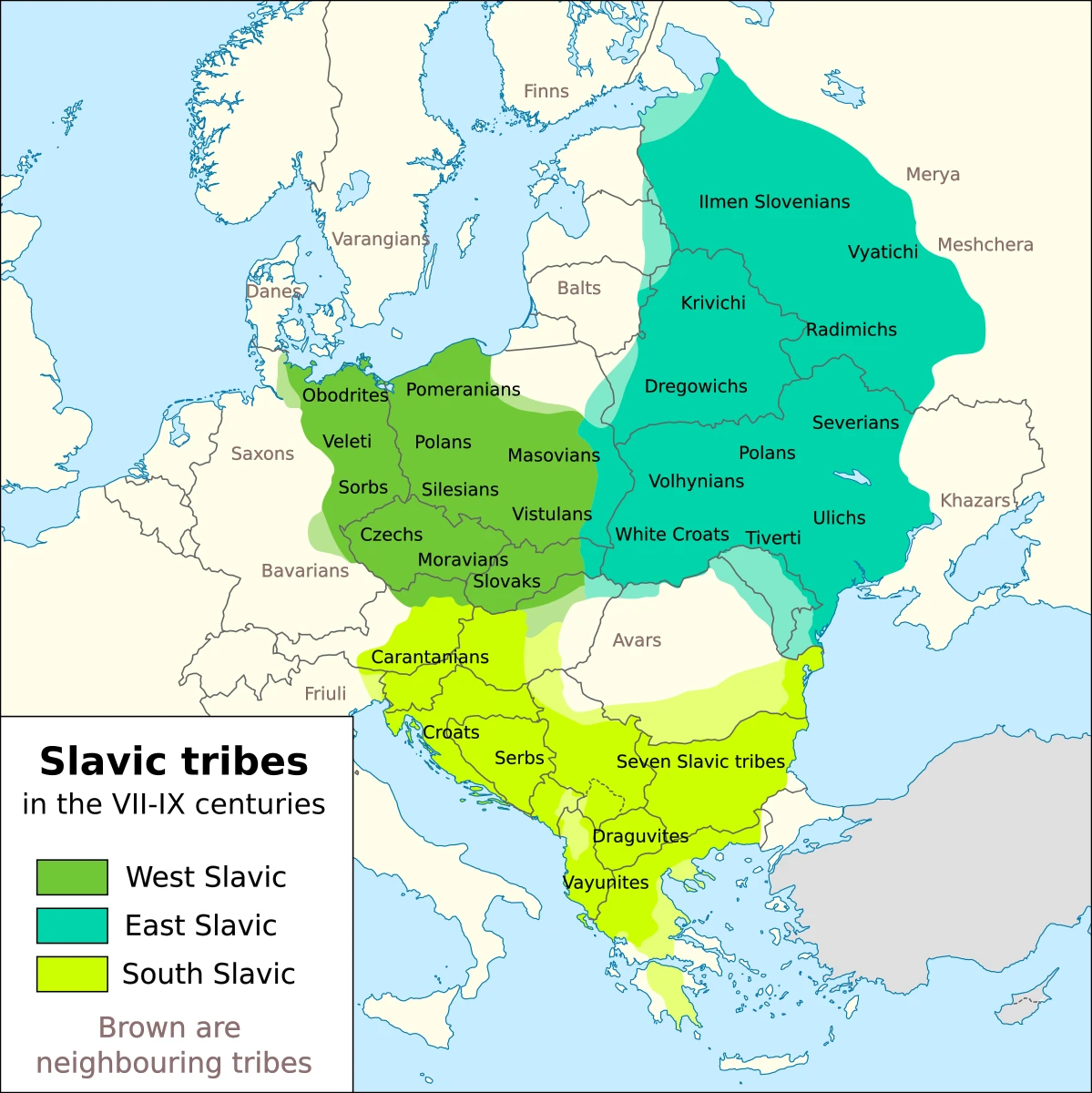
The early Slavs are almost invisible in the historical record until the sixth century, when Byzantine writers suddenly notice large numbers of them crossing the Danube and raiding imperial territory. Where they came from is debated, but the likeliest answer points to the forests and marshlands of the Pripyat basin, in what is now northern Ukraine and southern Belarus. From that core they expanded in every direction with remarkable speed: westward to the Elbe, southward into the Balkans, eastward across the forest zone. By the seventh century Slavic-speaking peoples occupied more of Europe than any other linguistic group.
They did not expand as a conquering army. The Slavic spread was slow, agricultural, and largely peaceful: families moving into thinly populated forest, clearing land, planting crops, and merging with or displacing the sparse populations already there. No single king directed the movement. It happened the way a forest grows, one tree at a time.
The Slavs were a people of the forest and the river. Their settlements occupied clearings in the woodland, typically on riverbanks or near lakes, where the soil was best and water provided transport. A village consisted of a cluster of semi-sunken log houses, their lower halves dug into the earth for warmth, with clay ovens built into one corner. Everything was wood: walls, roofs, fences, tools, storage buildings, the footbridges across marshy ground. Stone construction was almost unknown. A Slavic settlement burned easily and was rebuilt just as easily, using the same timber that surrounded it on every side.
Rye and millet were the staple crops, supplemented by garden vegetables, forest mushrooms, honey, and river fish. A woman kneeling by a river in early morning, checking a wicker fish trap set the evening before, was performing a task that had not changed in centuries and would not change for centuries more. Livestock meant cattle, pigs, and chickens. Horses were kept but not commonly ridden; oxen pulled the plow. The forest provided fuel, building material, game, and the ash that fertilized freshly cleared fields in the slash-and-burn cycle that defined Slavic agriculture.
Byzantine writers described the Slavs as disorganized, lightly armed, and impossible to pin down. They fought on foot with javelins, bows, and simple shields. They avoided open battle and excelled at ambush, using forests, rivers, and marshes as defensive terrain. Procopius noted that they could hide underwater in rivers, breathing through hollow reeds, and emerge behind an enemy who thought the crossing was clear.
Political organization was minimal. Tribal chiefs led by consent, and decisions were made in assemblies of free men. The first Slavic state of any size was Samo's kingdom in the early seventh century, a loose confederation of tribes in central Europe that held together for a single generation before dissolving at its founder's death. Great Moravia, which emerged in the ninth century in the Danube region, was more durable and more ambitious. Its rulers invited the Byzantine missionaries Cyril and Methodius to create a Slavic alphabet and translate Christian texts, producing the foundations of Slavic literacy. Great Moravia fell to Magyar invasions around 907, but the literary and religious traditions it fostered survived in the Slavic states that came after.
Slavic religion was local, practical, and tied to the landscape. There was no centralized priesthood and no written doctrine. Sacred groves, springs, and hilltop sites served as places of offering. The gods presided over specific concerns: Perun over thunder and war, Veles over cattle and the underworld, Mokosh over weaving and women's work. A farmer burying a clay pot of grain at the edge of his field in autumn was asking something of someone, though the exact theology behind the gesture varied from village to village.
The household was the basic unit of society, and households were organized into extended kin-groups that shared labor, land, and obligations. Marriage involved bride-price negotiations between families. The dead were cremated, their ashes placed in urns and buried in flat cemeteries without elaborate markers. Social hierarchy existed but sat lightly: a chief was first among equals, richer in cattle and louder in the assembly, but not separated from his people by the kind of legal caste distinctions found among the Saxons or the Franks.
The Slavic expansion brought them into contact with every major power in Europe. In the west they bordered the Frankish kingdom and adopted Christianity from German missionaries. In the south they pressed against Byzantium and eventually settled the Balkans so thoroughly that the region's population became predominantly Slavic. In the east, Scandinavian traders and warriors moved through Slavic territory along the river routes from the Baltic to the Black Sea, and from this contact the principality of Rus' emerged in the ninth century, blending Norse leadership with a Slavic-speaking population.
The Slavic world that took shape by the end of the first millennium was enormous and diverse: Poles, Czechs, Serbs, Croats, Bulgarians, and the peoples of Rus' all traced their origins to the same forest-dwelling ancestors. What they shared was a linguistic family, a tradition of timber construction, an agricultural way of life tuned to the forest zone, and a memory of the old gods that persisted beneath the Christian surface for generations after formal conversion. The villages changed their prayers, but the log houses, the fish traps, and the rye fields stayed the same.

 , you may spend any number of
  instead of equal number of


 from each meadow hex with your

 ,
they inflict 1 extra damage to another
of your nearest
,
they inflict 1 extra damage to another
of your nearest
 in Sawmill area,
always use 1 action cube
in Sawmill area,
always use 1 action cube
In the game, the Slavs build a civilization from timber. Wood replaces stone for everything, echoing the zrubna log construction tradition where entire cities rose without a single quarried block. Meadow peasants gather extra food, and the sawmill never costs more than 1 action cube. The price is that fire spreads: damage to one structure bleeds to the nearest neighbor. Pour everything into an economic boom early, negotiate peace with your neighbors, and never leave buildings undefended by at least a peasant. Stockpile cheap wood for future ages so you can eventually pull your peasants out of the forests for other work.
Yes. The ability says you may spend any number of wood instead of an equal number of stone when constructing structures. This applies to all structures including cities and castles. You can replace every stone cost with wood.
You gather +1 food from each meadow hex that has your peasant, so +2 extra food total on top of normal gathering.
It means your structure on the hex closest to the battle hex, not on the battle hex itself. If multiple structures are equidistant, your opponent chooses which one receives the extra damage. There is no maximum distance.
No. It triggers whenever your opponent deals at least 1 damage to your structure during any battle, regardless of who initiated it. Even if you attacked, if the defender damages your structure, they also inflict 1 extra damage to your nearest structure.