1-995 CE
The Uralians were the scattered forest and steppe peoples of the Ural mountains and beyond, hunters, fishers, and reindeer herders who lived at the edge of the known world and whose descendants include the Finns, Estonians, Sámi, and Magyars.
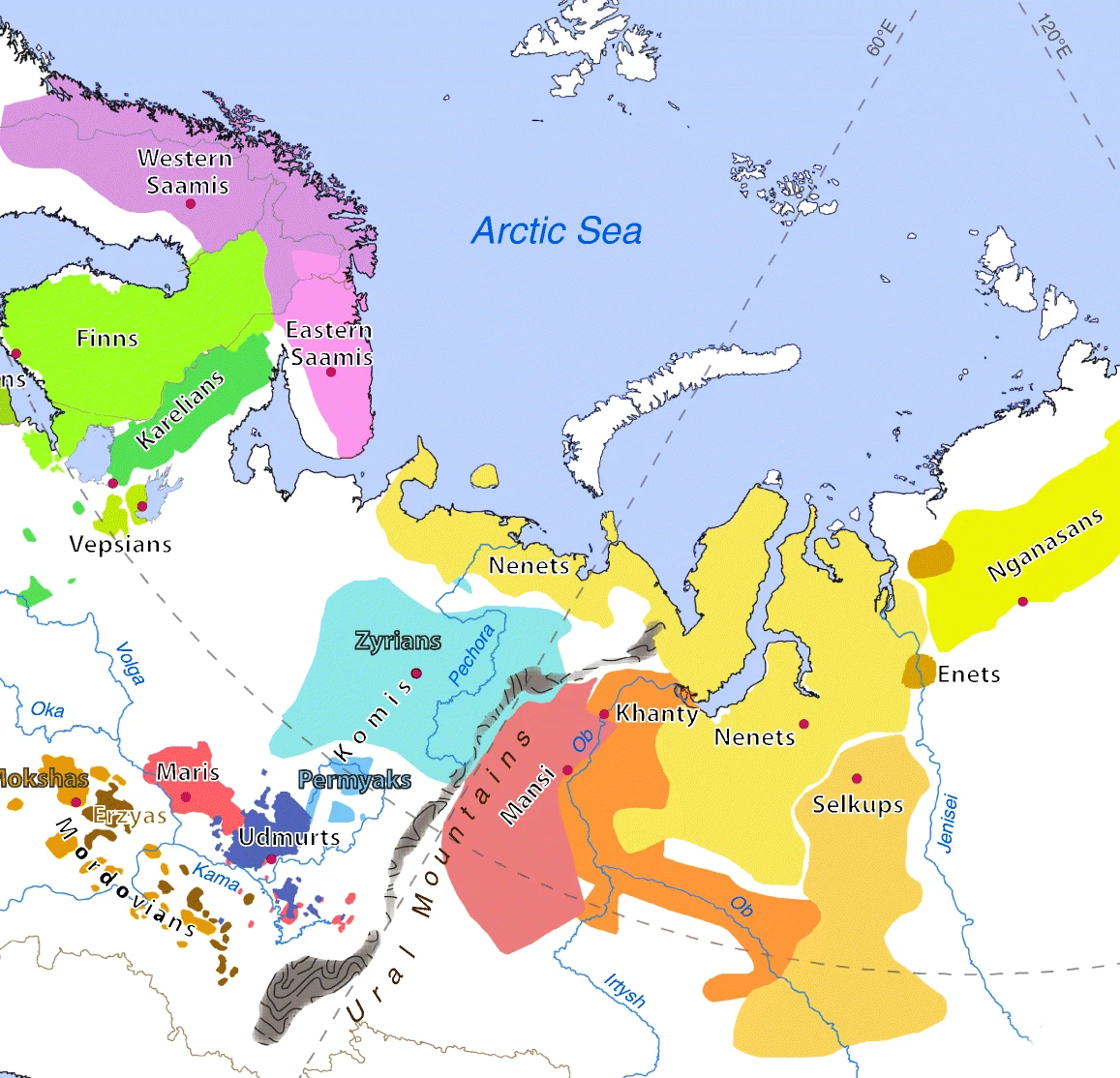
The Uralic peoples were a loose family of linguistically related groups spread across a vast arc from the forests of Finland to the western Siberian steppe. They were not a nation, not a confederation, and not even aware of each other as kin in most cases. What connected them was a family of languages whose common ancestor had been spoken somewhere near the Ural mountains thousands of years earlier. By the first centuries of the common era this family had splintered into dozens of branches: the ancestors of the Finns and Estonians along the Baltic, the Sámi in the subarctic north, the Permians and Mordvins in the middle Volga forests, and the Magyars on the steppe beyond.
These were peoples of the periphery. They lived where the farmland ran out and the forest or the steppe took over, and most of them entered written history only when literate neighbors finally reached their territory.
The range of Uralic habitats was enormous. A Sámi family following reindeer herds across the tundra of northern Scandinavia and a Magyar horseman riding the Pontic steppe shared distant linguistic roots but nothing else. Between these extremes lay the taiga zone: endless coniferous forest broken by rivers, bogs, and lakes, where most Uralic groups made their living.
Life in the taiga followed the seasons with little room for error. A family in the Volga-Kama forests hunted elk and beaver in winter, fished the rivers when the ice broke in spring, gathered berries and mushrooms in summer, and stored what it could for the months when the forest gave nothing. Grain agriculture reached some groups, especially those nearest the Baltic or the steppe edge, but for many the forest itself was the field. A man setting a deadfall trap for a marten on a December morning, working with numb fingers in failing light, was engaged in the activity that defined his people's economy. Furs were both clothing and currency, the one product that connected these remote communities to the wider world.
Most Uralic groups were too small and too scattered for organized warfare. Raiding between neighboring clans happened, and fortified hilltop refuges have been found across the forest zone, but armies in any conventional sense were rare. Defense meant disappearing: retreating deeper into forest or bog where pursuers could not follow. A people who knew every stream crossing and game trail in a hundred square kilometers of trackless woodland did not need walls.
The great exception was the Magyars. By the ninth century this Uralic-speaking group had moved from the forest-steppe zone into the open grasslands north of the Black Sea, adopted a fully nomadic horse-warrior culture, and become one of the most feared raiding peoples in Europe. Their mounted archers terrorized central Europe for decades before settling in the Carpathian basin around 896 and founding the kingdom of Hungary. The Magyar transformation from forest hunters to steppe cavalry to Christian kingdom happened in a few centuries, one of the most dramatic cultural pivots of the early medieval period.
Uralic religions shared certain deep structures: a cosmos divided into upper, middle, and lower worlds connected by a world-tree or world-pillar; shamans who traveled between these layers in trance to heal the sick, find lost animals, or communicate with the dead. The shaman's drum, painted with cosmological images and beaten in rhythm to induce the trance state, was the central ritual object. Offerings were left at sacred trees, stones, and water sources. Bear ceremonies, in which a hunted bear was honored with elaborate rituals and apologies before its meat was eaten, are documented among Finnic and Ugric peoples and may reflect traditions of great antiquity.
Social organization was kin-based and egalitarian by necessity. A community of forty people living in a forest clearing could not afford rigid hierarchy. Decisions were made by consensus among household heads. Women processed hides, made clothing, managed food storage, and in some groups controlled the distribution of the fur surplus that constituted the community's only tradeable wealth. Marriage tied families across distances, creating networks of obligation that provided insurance against local famine: a bad year on one river could be survived if relatives on another river had surplus fish to share.
The fur trade drew Uralic peoples into contact with distant civilizations. Arab silver dirhams reached the Volga-Kama region in quantity, exchanged for beaver and sable pelts that ended up as luxury garments in Baghdad and Constantinople. Norse traders moving along the eastern river routes dealt with Finnic and Permian groups as both partners and prey. The Baltic Finns, closest to Scandinavia and the emerging states of the medieval west, were the first to be drawn into the Christian orbit: Finnish and Estonian communities encountered Swedish and Danish missionaries from the eleventh century onward.
The Uralic linguistic family survives today in Finnish, Estonian, Hungarian, and a constellation of smaller languages across northern Eurasia. The Sámi still herd reindeer in the subarctic. The cultural distance between a Hungarian parliamentary session in Budapest and a Khanty fishing camp on the Ob river in western Siberia is almost immeasurable, yet the languages spoken in both places descend from the same source, a reminder that human history does not always follow the lines that maps suggest.

 may gather
  from hexes with calamity

 and
and 

 in each
  , where you have at least 2
 using experience cubes
In the game, the Uralians extract a living from land nobody else wants. Peasants appear wherever enough units gather rather than through recruitment, experience cubes work as gatherers, and even calamity hexes yield resources. This is a nation shaped by the taiga: sparse, patient, and surprisingly resilient. Spread units across multiple provinces in pairs early to maximize peasant generation during the achievement phase. Your economy starts slow but scales with map presence.
No. You gain 1 peasant per province regardless of how many units you have there, as long as you have at least 2 units. Spreading your units across multiple provinces with 2 units each maximizes peasant gains.
Yes. Any combination of units counts. If you have 1 peasant and 1 Galley in a province, you meet the requirement and gain 1 peasant during the achievement phase.
No. The word "cannot" has the highest authority in the rules. Your nation's restriction on recruiting peasants overrides any ability that would allow you to recruit them, including adopted alliance abilities or technologies.
Yes. Since you may use experience cubes to gather resources, you can mix them with action cubes. For example, if re-gathering requires 2 cubes, you could spend 1 action cube and 1 experience cube.