1-1009 CE
The Balts were the last pagan peoples of Europe, inhabiting the dense forests, amber coastlines, and trackless marshes along the eastern shore of the Baltic Sea, where outsiders entered at their own risk and often did not leave.
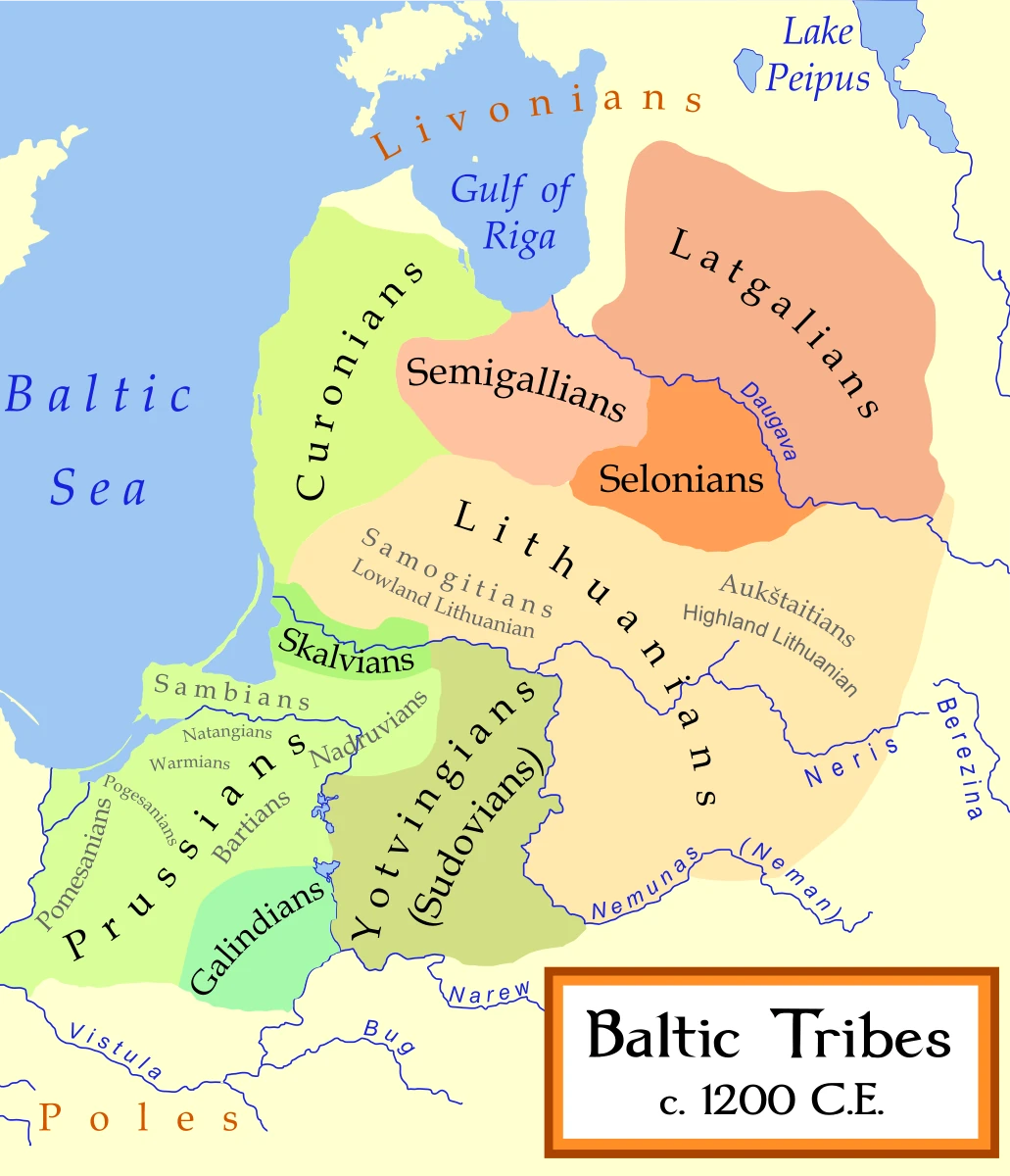
The Balts were an ancient group of Indo-European peoples who occupied the southeastern shore of the Baltic Sea and its forested hinterland, from roughly the Vistula in the west to the upper Dnieper in the east. Tacitus mentioned them as the Aesti, praising their patience and their amber. They spoke languages ancestral to modern Lithuanian and Latvian, among the most archaic surviving branches of the Indo-European family. A Lithuanian farmer of the twentieth century used words for basic kinship and numbers that a linguist could trace back to forms older than Latin or Greek.
They were not a single nation. Prussians, Curonians, Semigallians, Yotvingians, Lithuanians, Latvians: the names multiplied across a landscape that discouraged unity and rewarded local knowledge. What bound them was language, religion, and geography.
Baltic territory was a world of water and wood. The coastline produced amber, the fossilized resin that had drawn Mediterranean traders north since the Bronze Age. Inland, the country dissolved into a maze of forest, bog, lake, and slow river. Roads were few and seasonal. A stranger following a path through a Baltic marsh in spring might find the ground solid one step and knee-deep in black water the next. Locals knew which hummocks held weight and which did not. This was not just geography but defense.
Farms occupied clearings in the forest, worked by families who grew rye, barley, and flax on the lighter soils. Beekeeping was widespread, and honey was both food and export. Fish from the rivers and the coast supplemented the grain diet. A Baltic homestead was a timber longhouse surrounded by outbuildings for livestock, grain storage, and a sauna. Winter lasted five months, and a family that had not smoked enough fish and stored enough grain by October faced real hunger before the spring thaw broke the ice on the rivers.
The Balts were not great conquerors. Their military strength was defensive: the forests, bogs, and lakes that made their country nearly impenetrable to outsiders. An invading army that followed the few passable tracks into Baltic territory found itself strung out in single file through swamp forest, vulnerable to ambush, unable to forage, and dependent on guides who might or might not be leading them into a trap. Viking raiders, Slavic war-bands, and later the crusading orders all learned that conquering the Balts required more patience than most campaigns could sustain.
Baltic warriors fought on foot with spears, axes, and short swords. Horses were used for raiding but not for the heavy cavalry charges that dominated warfare further south and west. Fortified hilltop settlements, often ringed by ditches and timber palisades, served as refuges during raids. Leadership was local: tribal chiefs and elders whose authority extended over a valley or a stretch of coast, not over a kingdom.
The Balts held onto their old religion longer than any other European people. Sacred groves, springs, and ancient oaks served as places of worship. Priests tended perpetual fires and interpreted omens. The gods bore names that echo across Indo-European mythology: Perkūnas the thunderer, Laima the goddess of fate. Snakes were sacred, kept alive in houses and fed milk from saucers. The dead were cremated on pyres with their horses, weapons, and personal goods, and the ashes buried under mounds that still dot the landscape.
A woman tying a ribbon around a sacred oak on midsummer night, a farmer pouring the first cup of ale onto the ground before drinking, a family leaving food at the grave of a grandfather on the anniversary of his death: these practices persisted not as self-conscious tradition but as the texture of daily life. Christian missionaries who arrived in the region found not organized resistance but a population that simply could not understand why the old ways needed changing. The conversion of the Baltic peoples, when it finally came, required military crusades and took centuries to complete.
Amber connected the Balts to the wider world. The fossilized resin, washed up on Baltic beaches after storms, had been traded south to the Mediterranean since prehistoric times. Roman-era amber routes carried the material through Germanic territory to the Danube and beyond. In return, Roman coins, bronze vessels, and glass beads flowed north. A woman on the Curonian coast wearing a necklace of blue glass beads in the third century was wearing the visible end of a trade chain that stretched to workshops in Egypt or Syria.
The Baltic peoples survived into the medieval period as the last major pagan population in Europe, a fact that drew crusaders, missionaries, and eventually the Teutonic Order to their shores. The Prussian Balts were conquered and largely assimilated by the thirteenth century. The Lithuanians resisted longest, building a grand duchy that became one of the largest states in late medieval Europe. The languages survived: Lithuanian and Latvian remain living tongues, carrying within their grammar and vocabulary structures so old that nineteenth-century linguists used them to reconstruct the common ancestor of all Indo-European speech.

 ,
you may replace 1 with a calamity
,
you may replace 1 with a calamity


 , they must spend 1
  or lose 1 engaged
  for each hex with a calamity they enter


 , pay -1
  and -2
  . Your have -1


 per engaged
In the game, the Balts make their homeland lethal to cross. Calamities replace adversities and force every invading unit to pay mead or die, hex by hex, like an army swallowed by marshland without a local guide. Your own troops move freely through the bogs. Cheap fragile vessels fish the coast for food through peaceful maneuvers. Stockpile calamities in your border provinces and let opponents waste resources trying to reach you. Your defense costs them more than it costs you.
On any hex in a province you control that does not already contain a calamity. You choose which hex receives the calamity.
Yes. You lose control of a province only after the maneuver completes. During the maneuver the province is still yours, so the opponent must spend 1 mead or lose 1 engaged unit for each hex with a calamity they move through or onto.
Yes. The choice is per hex: for each hex with a calamity, the opponent independently decides whether to spend 1 mead or lose 1 engaged unit. They can mix and match across different hexes in a single maneuver.
No. The ability specifies "when an opponent would maneuver." Your own units move through calamity hexes in your provinces freely.
No. The -1 HP penalty is tied to the Balts' ability, which is valid through Age I and Age II. When Age III begins, the ability expires. All your surviving vessels immediately regain that hit point, and any new vessels you recruit have their full HP.