150-711 CE
The Goths were an East Germanic people who migrated from the Baltic coast to the Black Sea steppe and then broke into the Roman Empire, splitting into Visigoths and Ostrogoths and founding kingdoms in Italy, Gaul, and Iberia that shaped the post-Roman world for three centuries.
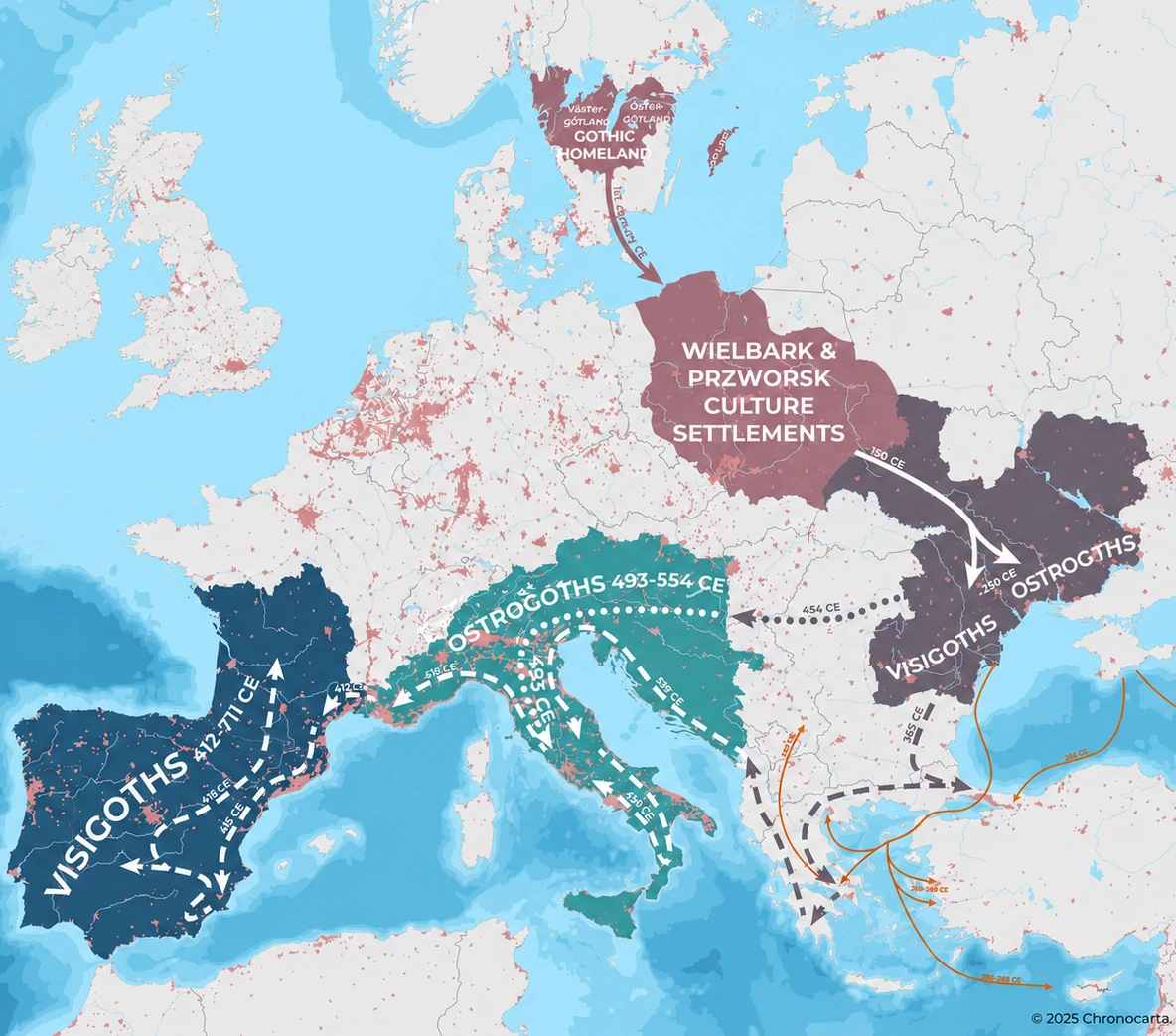
The Goths were an East Germanic people whose origin stories pointed to Scandinavia, though by the time they enter the historical record they occupied the southern Baltic coast around the Vistula. Over the course of several centuries they drifted southeast to the Black Sea steppe, where they split into two broad groupings: the Visigoths in the west and the Ostrogoths in the east. The split was political and geographic rather than ethnic; they spoke the same language, shared the same customs, and regarded each other as kin.
What made the Goths distinctive was their capacity to absorb. They borrowed from every culture they encountered: Sarmatian cavalry tactics on the steppe, Roman administrative methods in the provinces, Arian Christianity from missionaries who reached them before the Catholic church did. They were not destroyers of civilization but aggressive tenants who moved into Roman buildings and tried to keep them standing.
The Goths had no permanent homeland in the way that settled peoples did. Their history is a sequence of territories occupied, worked for a few generations, and then left behind. On the Black Sea steppe they became herders and grain farmers on the rich chernozem soils, trading surplus wheat to Roman merchants. In Gaul and Iberia the Visigoths took over Roman estates and divided land with the existing population under a system of hospitalitas. An Ostrogothic nobleman in sixth-century Italy might live in a Roman villa, employ Roman scribes, and eat from Roman tableware while carrying a Gothic sword.
Ordinary Gothic families in Iberia farmed much as their Roman and Hispano-Celtic neighbors did. Olive groves and vineyards in the south, grain and livestock in the central plateau. A peasant woman pressing olives in autumn outside Toledo would have been indistinguishable from her non-Gothic neighbor except perhaps by the brooch at her shoulder, a distinctive eagle- or S-shaped fibula that marked Gothic fashion across every territory they settled.
Gothic warfare combined Germanic infantry tradition with cavalry skills learned on the steppe. At Adrianople in 378, Gothic horsemen destroyed a Roman army and killed the emperor Valens, a shock that reverberated for generations. The lesson was that mobile heavy cavalry could break disciplined infantry, and the Goths applied it repeatedly. But their armies were not large. Gothic military strength depended on a warrior aristocracy supported by a broader population of farmers who could be called up in emergencies but were not professional soldiers.
The Visigothic kingdom in Iberia, centered on Toledo, lasted from the early fifth century to the Arab conquest in 711. Its weakness was at the top: the throne was elective among the nobility, and nearly every succession produced a faction fight. Kings were murdered, blinded, or driven into exile with numbing regularity. The kingdom that fell to Tariq's army at the Guadalete river in 711 was already fractured by civil war. A stronger state might have survived the invasion; the Visigoths could not hold together long enough to resist it.
The Goths converted to Arian Christianity in the fourth century, largely through the work of Wulfila, who translated the Bible into Gothic and in doing so created the first literary work in any Germanic language. The Gothic Bible required an alphabet, and Wulfila invented one, borrowing from Greek, Latin, and runic scripts. His translation survived in fragments, the most famous being the Codex Argenteus, written in silver and gold ink on purple vellum.
Arianism set the Goths apart from their Catholic Roman subjects for over a century. The division was as much social as theological: Gothic warriors attended their own churches, married within their own community, and maintained a legal identity separate from the Roman population. When the Visigothic king Reccared converted to Catholicism at the Third Council of Toledo in 589, the move was less about doctrine than about removing the barrier between rulers and ruled. After conversion the two populations merged rapidly, and the Gothic language disappeared within a generation or two.
Gothic kingdoms were the most successful of the barbarian successor states in terms of longevity and cultural absorption. The Ostrogothic kingdom in Italy under Theodoric preserved Roman civic institutions, repaired aqueducts, and patronized Latin scholarship. The Visigothic kingdom in Iberia developed a legal code, the Liber Iudiciorum, that would influence Iberian law for centuries after the kingdom itself was gone.
The Goths left no living language and no continuous political descendant. What they left was a method: the demonstration that a Germanic warrior elite could take over a Roman province, keep its economy running, adopt its religion, merge with its population, and produce something that was neither fully Roman nor fully Germanic but workable. Every medieval kingdom in western Europe followed some version of this template, whether its rulers knew it or not.

 on an adjacent hex


 from each hex with
at least 2 of your
from each hex with
at least 2 of your


 ,
replace all rebels there with your
,
replace all rebels there with your  of the same type, then overcome their

 and revealing an
  ,
place 1 more cube of your color
on the revealed
,
place 1 more cube of your color
on the revealed
In the game, the Goths settle fast and settle densely. Free peasants appear whenever a city or castle goes up, and packed hexes yield extra resources. Winning in enemy territory flips rebels to your side, since Goths served every kingdom and any province's malcontents likely included compatriots. Extra cubes on revealed events strengthen both your voting position and your battle bag, giving you political weight and military reserves from exploration alone. Explore as many provinces as possible early; the Goths can rush or boom equally well, since you can skip heavy military investment if you prefer to win through economy and politics.
Yes. The ability says to "overcome their adversity," which means removing all adversity cubes from the units. The rebels become normal units under your control with no adversity.
Yes. The standard rules for overcoming adversity apply. You gain 1 glory for each adversity cube discarded, just as you would when using the Overcome free action.
The peasant comes from your supply. If you have no peasants available in your supply, you cannot gain one from this ability.
You gather the standard amount from the hex plus your peasants' contribution, plus 1 extra from your ability because you have at least 2 peasants on that hex. The bonus is +1 per hex regardless of whether you have 2 or 5 peasants there.
The cube comes from your supply, as with other abilities that place cubes.
No. The ability specifies "in an enemy province." Your own provinces do not qualify, even if they contain rebels.